BREAST IMPLANTS & SAFETY
Breast implants are implantable medical devices used in reconstructive and cosmetic surgery. When indicated, placed, and monitored appropriately, they can provide real benefits. However, like any implantable device, they require comprehensive information, regular follow-up, and specialized care in case of complications.
At Dr. Danino's practice, breast implant care is based on a scientific, measured, and individualized approach.
Periprosthetic Capsule and Implant-Tissue Interactions
After breast implant placement, the body naturally develops a fibrous capsule around it. This reaction is physiological but can, in some cases, become pathological.
Dr. Danino's work has contributed to a better understanding of the periprosthetic capsule, particularly its structure and its interaction with silicone.
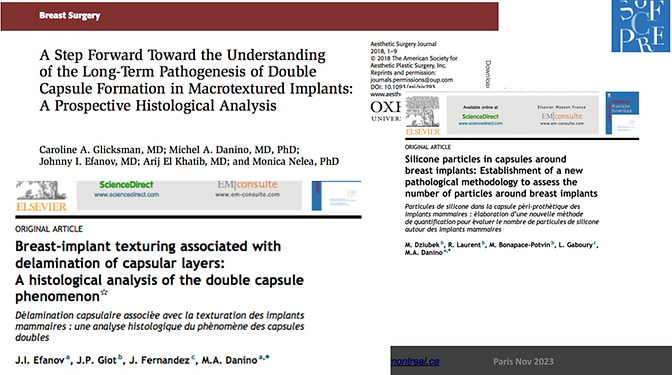
Danino MA et al. Silicone particles in capsules around breast implants. Aesthetic Surgery Journal.
https://pubmed.ncbi.nlm.nih.gov/38078367/
Implant Surface and Capsular Organization
The surface area of breast implants directly influences the organization of the capsule.
The work of Danino MA et al. described the double-capsule phenomenon associated with macro-textured implants, contributing to the evolution of clinical practices and recommendations.
Danino MA et al. Breast-implant macro-texturing associated with delamination of capsular layers. Plastic and Reconstructive Surgery.
https://pubmed.ncbi.nlm.nih.gov/28284510/
Long-Term Follow-Up of Breast Implants
There is no automatic lifespan for breast implants. Follow-up is based primarily on clinical examination, supplemented by imaging when necessary.
The decision to replace or remove an implant is individualized and based on the clinical presentation and overall context.
Implant Removal and Capsulectomy
Breast implant removal may be indicated in various clinical situations.
Capsulectomy, which involves removing all or part of the capsule, is never routinely performed. Its indication is based on a rigorous clinical and scientific analysis, informed by experience in reconstructive surgery and data from the literature.
Information and Shared Decision-Making
Preoperative information includes the expected benefits, risks, limitations, and alternatives.
This transparency is essential for informed decision-making and long-term follow-up.